Artificial Intelligence

Guterres advances the global AI agenda

Following the appointment of forty experts to the Independent International Scientific Panel on Artificial Intelligence (AI), the UN Secretary‑General continues advancing the global AI agenda by participating at the India AI Impact Summit 2026 (18–20 February, New Delhi). The Summit focuses on how AI can benefit humanity and support inclusive growth through the pillars of People, Planet, and Progress. António Guterres took part in a high‑level session examining how scientific evidence and independent expertise can reinforce safe, trusted, and internationally coordinated AI governance.

The event is based on the principles of People, Planet and Progress. It envisions a future where AI advances humanity and safeguards the planet.
Photo:Adobe Stock/Dian
Firewood used to dry bricks in a massive oven in El Fasher, North Darfur. The production of bricks in Darfur is one of the most contaminating activities and erosive for the soil.

‘No corner of Sudan is safe’: UN officials warn of famine and atrocities as war intensifies

19 February 2026 — Nearly three years into Sudan’s war, violence is intensifying, famine conditions are looming in parts of the country, and civilians remain trapped between shifting front lines,...

Sudan: ‘Hallmarks of genocide’ found in El Fasher, UN investigators detail mass killings and ethnic targeting

19 February 2026 — The Rapid Support Forces (RSF) carried out ethnically targeted killings, widespread sexual violence and enforced disappearances during their late-October takeover of El Fasher...

Fears of ethnic cleansing in Gaza and the West Bank: UN rights report

19 February 2026 — Increased Israeli attacks and the forced transfer of Palestinians have sparked concern over ethnic cleansing in the Gaza Strip and the West Bank, the UN human rights office,...

UN Sustainable Development Goals

17 Goals to transform our world

The Sustainable Development Goals are a call for action by all countries — poor, rich and middle-income — to promote prosperity while protecting the planet.

hands holding megaphone and speech bubble

The Goals can improve life for all of us. Cleaner air. Safer cities. Equality. Better jobs. These issues matter to everyone. But progress is too slow. We have to act, urgently, to accelerate changes that add up to better lives on a healthier planet. Find new inspiring actions on the app and at un.org/actnow.

Today, half the world is under 30, and this generation is a powerful force for peace. The UN "Hear Us. Act Now for a Peaceful World" campaign, launched on the International Day of Peace, aims to include, invest in, and partner with young people to build lasting peace. 

children holding up books

Reading and learning are essential to children’s growth and development; stories can fuel their imagination and raise awareness of new possibilities. The SDG Book Club aims to encourage them to learn about the Goals in a fun, engaging way, empowering them to make a difference.

More from the
United Nations

Featured stories from across the United Nations and our world-wide family of agencies, funds, and programmes.

Kristin Davis with UNHCR staff and refugees Displaced Persons and Refugees, UNHCR

A call from South Sudan’s frontline of displacement

In Renk, South Sudan, United Nations High Commissioner for Refugees (UNHCR) Goodwill Ambassador Kristin Davis met families who have fled escalating violence, insecurity and human rights violations in Sudan – many for the second or third time. At the Joda border crossing and Renk Transit Centre, she saw UNHCR and partners providing shelter, health care, clean water, sanitation and protection, even as needs far exceed available resources and funding remains critically low. Women and children, who make up about 80 per cent of those fleeing, shared harrowing stories of violence and loss, while support services for survivors are being forced to close. Discover why Davis says this crisis “demands more attention, more resources and more action – now”.

woman holding bunch of grapes in vineyard Agriculture and Food, FAO

The science of grapes

In Georgia’s Kakheti region, 25-year-old viticulturist and winemaker Sophio Khutitdze is reshaping how grapes — and wine — are made. Trained in science and driven by a love of nature, she manages 40 hectares of vineyards, where quality starts with the grape, not the bottle. Through a UN Food and Agriculture Organization (FAO) project funded by the European Union and Sweden, she is using pheromone-based “mating disruption” to control the destructive European grapevine moth, cutting pesticide use while protecting yields and food safety. As a newly trained trainer, she now shares integrated vineyard management techniques with others, joining 23 wineries across four regions that are adopting sustainable practices. Discover how Sophio and her peers are transforming Georgia’s wine sector.

youth in vegetable garden Youth, Agriculture and Food, IFAD

The power of rural youth

Rural young people are vital to global development, with nearly half of the world’s 1.3 billion youth living in rural areas and brimming with entrepreneurial potential. Yet they often lack access to opportunities that enable them to thrive. Targeted investments, through IFAD’s youth-sensitive programmes, are unlocking that potential — creating jobs, fostering agribusiness leadership and strengthening rural economies. By nurturing skills, providing access to finance and connecting youth with markets, initiatives like Agribusiness Hubs empower young people to build sustainable futures in their communities rather than migrating elsewhere. These success stories underscore why investing in rural youth is essential for food security, economic growth and lasting stability.

Child and Youth Safety Online, UNFPA

Digital shift in child marriage

As societies go digital, technology is reshaping child marriage, both enabling harmful practices and empowering girls to resist and seek support.

Intellectual and Cultural Property

Made in Africa

A new International Trade Centre report finds strong backing for the African Union’s Made in Africa label, with quality viewed as key to boosting trade under the African Continental Free Trade Area.

Humanitarian Aid, UNESCO

Rebuilding hope after Hurricane Melissa

After Hurricane Melissa disrupted education for over half a million students in eastern Cuba, the “Rebuilding Hope” initiative was launched to restore learning, provide psychosocial support, and strengthen resilience in affected schools.

Migrants, IOM

From migrant to culinary star

In Bujumbura, Congolese migrant Joyce built a thriving restaurant through social media, creating jobs and uniting communities through shared cuisine.

What we do

Due to the powers vested in its Charter and its unique international character, the United Nations can take action on the issues confronting humanity in the 21st century, including:

Structure of the
United Nations

The main parts of the UN structure are the General Assembly, the
Security Council, the Economic and Social Council, the Trusteeship Council, the International Court of Justice, and the UN Secretariat. All were established in 1945 when the UN was founded.

The General Assembly is the main deliberative, policymaking and representative organ of the UN. All 193 Member States of the UN are represented in the General Assembly, making it the only UN body with universal representation.

The Security Council has primary responsibility, under the UN Charter, for the maintenance of international peace and security. It has 15 Members (5 permanent and 10 non-permanent members). Each Member has one vote. Under the Charter, all Member States are obligated to comply with Council decisions.

The Economic and Social Council is the principal body for coordination, policy review, policy dialogue and recommendations on economic, social and environmental issues, as well as implementation of internationally agreed development goals.

The Trusteeship Council was established in 1945 by the UN Charter, under Chapter XIII, to provide international supervision for 11 Trust Territories that had been placed under the administration of seven Member States, and ensure that adequate steps were taken to prepare the Territories for self-government and independence.

The International Court of Justice is the principal judicial organ of the United Nations. Its seat is at the Peace Palace in the Hague (Netherlands). It is the only one of the six principal organs of the United Nations not located in New York (United States of America).

The Secretariat comprises the Secretary-General and tens of thousands of international UN staff members who carry out the day-to-day work of the UN as mandated by the General Assembly and the Organization's other principal organs.

Learn more

Podium of the General Assembly Hall seen from below with the gold wall and the golden UN logo behind

On 25 November 2025, the President of the General Assembly and the President of the Security Council initiated the process of selecting and appointing the next Secretary-General. Candidates are nominated by a Member State or a group of Member States. Learn more about the multi-step selection and appointment process of the next United Nations Secretary-General.

Climate change is the defining issue of our time and now is the defining moment to do something about it. There is still time to tackle climate change, but it will require an unprecedented effort from all sectors of society.

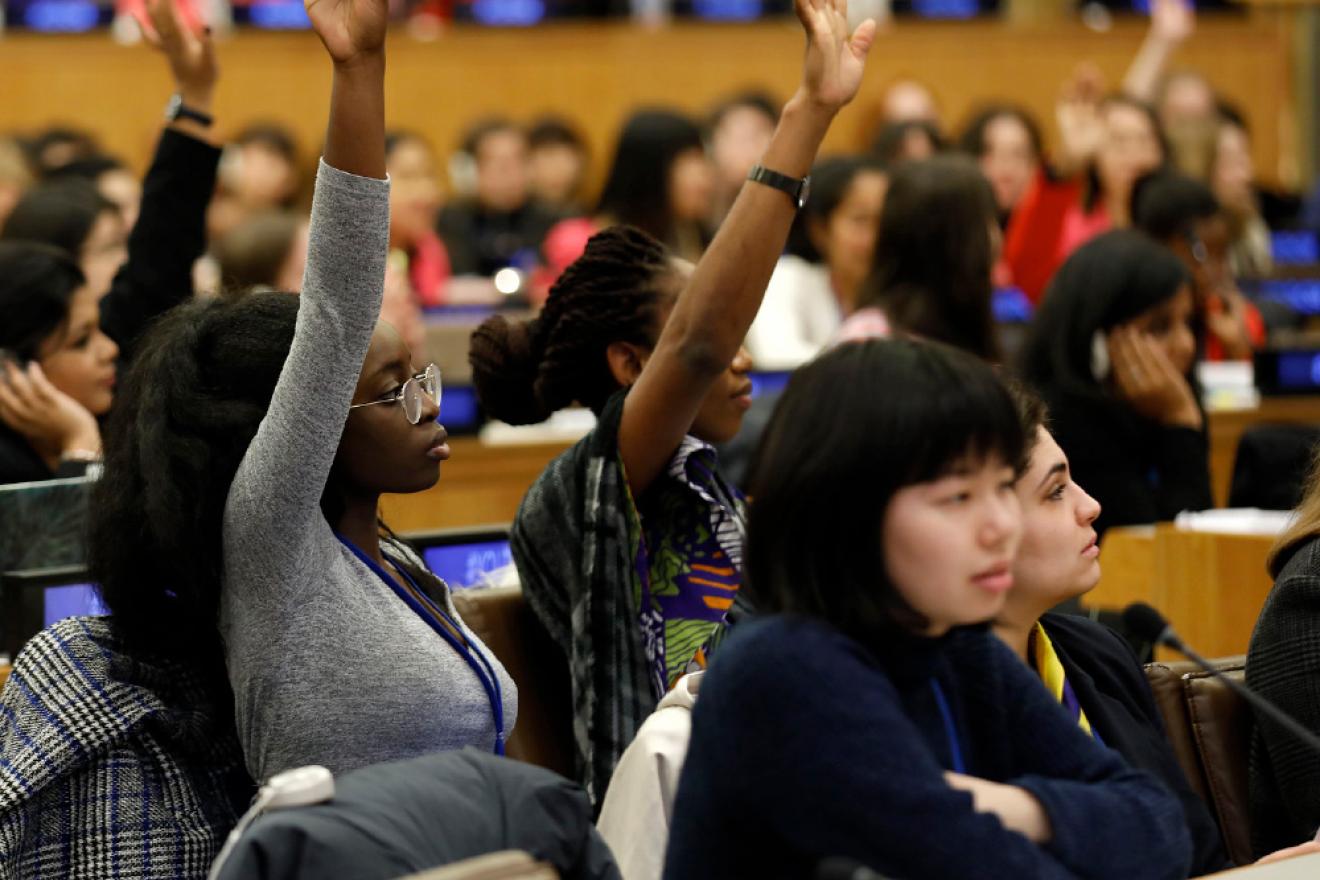
Women at UN CSW63 Side Event - “Take the Hot Seat”. Photo: UN Women/Ryan Brown

Women and girls represent half of the world’s population and, therefore, also half of its potential. Gender equality, besides being a fundamental human right, is essential to achieve peaceful societies, with full human potential and sustainable development.

UN Secretary-General António Guterres is greeted on his visit to the Central African Republic

While global poverty rates have been cut by more than half since 2000, one in ten people in developing regions still lives on less than US$1.90 a day — the internationally agreed poverty line, and millions of others live on slightly more than this daily amount.

Watch and Listen

Video and audio from across the United Nations and our world-wide family of agencies, funds, and programmes.

Women and children displaced by violence in Sudan are walking for up to 40 days to reach safety, with pregnant women giving birth along the way. UNFPA, led by Fabrizia Falcione, is on the ground providing urgent healthcare and support to save lives amid this crisis.

Bring hope this Ramadan

As humanitarian crises worsen across the globe, countless families are struggling without enough food, shelter, or basic necessities. This Holy Month, share your blessings, your compassion has the power to save lives.

OHCHR: 5th International Minority Artists Contest

UN Human Rights launches the 5th International Minority Artists Contest: War and Reconciliation. Share creativity, challenge injustice, inspire change, apply today!

UN Podcasts

children sitting in front of tents in refugee camp

Sudan: No school or safety for children uprooted by war

In Sudan, the conflict between the national army and the paramilitary Rapid Support Forces (RSF) has plunged the country into widespread bloodshed and humanitarian catastrophe. 

The devastating civil war began in April 2023 and is expanding beyond the western Darfur region into central Kordofan, taking its toll on civilians and particularly the most vulnerable, including children.

Eva Hinds, Spokesperson for the UN Children's Fund (UNICEF) in Sudan, describes how the agency is supporting boys and girls amid the brutal conflict and ongoing cuts to aid budgets.

Latest Audio from UN News

The United Nations in Pictures

Images from across the United Nations and our world-wide family of agencies, funds, and programmes.

a woman sits amongst young girls with a comic book in her hands and all are wearing veils
Photo:©UNFPA

Akimatou - from teen mother to trailblazer 

Akimatou, a 22-year old entrepreneur, is helping rewrite girls’ futures in Benin. After becoming a mother at 16 and leaving school, Akimatou turned her second chance into a mission - using bold comics and open conversations to help girls in Benin take control of their bodies and futures. Now a thriving entrepreneur and mentor, she’s transforming her own story of hardship into hope for an entire generation. Her work is part of a UNFPA-supported comprehensive sexuality education initiative that has driven big gains in reducing school-related pregnancies and expanding girls’ opportunities

Leen dressed in a lilac jumper and white veil holds a yellow ball that has eyes
Photo:©UNDP Syria/Adeeb Alsayed

Voo - a little helper by Leen

Exposed to the world of science, technology, engineering and mathmatics (STEM) at a young age, Leen Alaya, a 24-year old innovator from Aleppo, Syria, is on a mission to revolutionize the way children learn programming - with a little help from UNDP. “Some of my earliest memories are of accompanying my mother to work at the University, where she was a professor in the Faculty of Computer Systems Engineering,” recalls Leen. By age eight, she was participating in national informatics Olympiads and hackathons, demonstrating a keen interest in problem-solving and programming. Read all about her innovation called Voo